The stone guide
Aquamarine
The colour of still water.
- Mineral family
- Beryl
- Colour
- Pale blue to blue-green, transparent
- Hardness
- 7.5 to 8 on the Mohs scale
- Usual cut
- Usually faceted, to move light through the stone
- Traditionally for
- Clarity, Calm
- Origin
- Sourced through our Jaipur partner
What it actually is
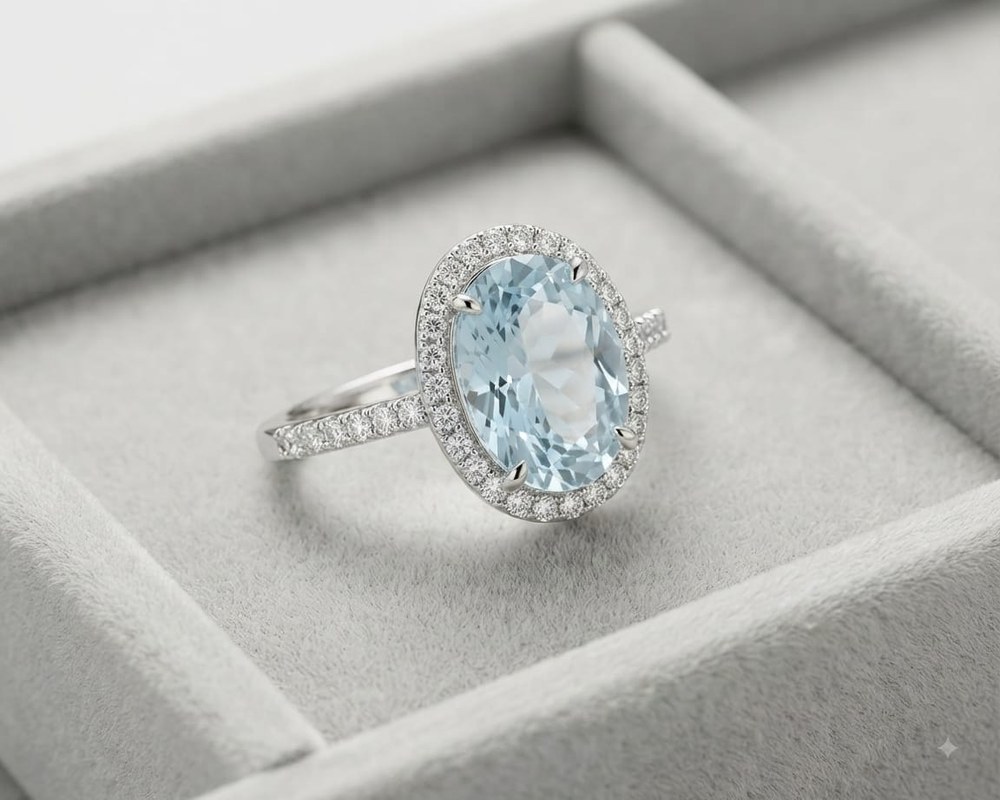
Aquamarine is beryl, the same mineral family as emerald, coloured by traces of iron. Because it is transparent and hard it is cut with facets rather than domed, so light travels into the stone, bounces off the back faces and comes out through the top. That is why it reads as bright rather than glowing.
How it looks in different light
The colour is more saturated in daylight and can flatten under warm bulbs, which push it slightly green. Larger stones show deeper colour than small ones cut from the same rough, because light has further to travel.
Natural characteristics
Colour ranges from barely-there blue to a definite sea green. Faint internal lines are common in beryl and are not a defect. Most aquamarine on the market is heat treated to stabilise the blue: our disclosure is on each product page.
Durability and care
At 7.5 to 8 this is one of the more durable stones we set, and fine for daily wear. Warm soapy water and a soft brush. Avoid sudden temperature changes.
The full care guide covers storage, cleaning and what to avoid across every stone we set.
Traditional associations
In crystal traditions Aquamarine is most often connected with clarity and calm.
Wearing Aquamarine
We set Aquamarine in the Aperture Ring, the Crescent Stud, the Halo Ring, the Iris Pendant, the Lucent Ring, the Oculus Cuff, the Petal Drop, the Strand Bracelet and the Wave Cuff. Against rhodium-finished silver it reads cool and recessive, which is the point: the metal holds the stone and gets out of the way.
In this stone
9 pieces in Aquamarine
Keep looking