The stone guide
Lapis Lazuli
Blue with gold inside it.
- Mineral family
- Rock, mainly lazurite
- Colour
- Deep blue, usually with gold pyrite flecks
- Hardness
- 5 to 6 on the Mohs scale
- Usual cut
- Cabochon or flat, cut to place the pyrite well
- Traditionally for
- Clarity, Confidence
- Origin
- Sourced through our Jaipur partner
What it actually is
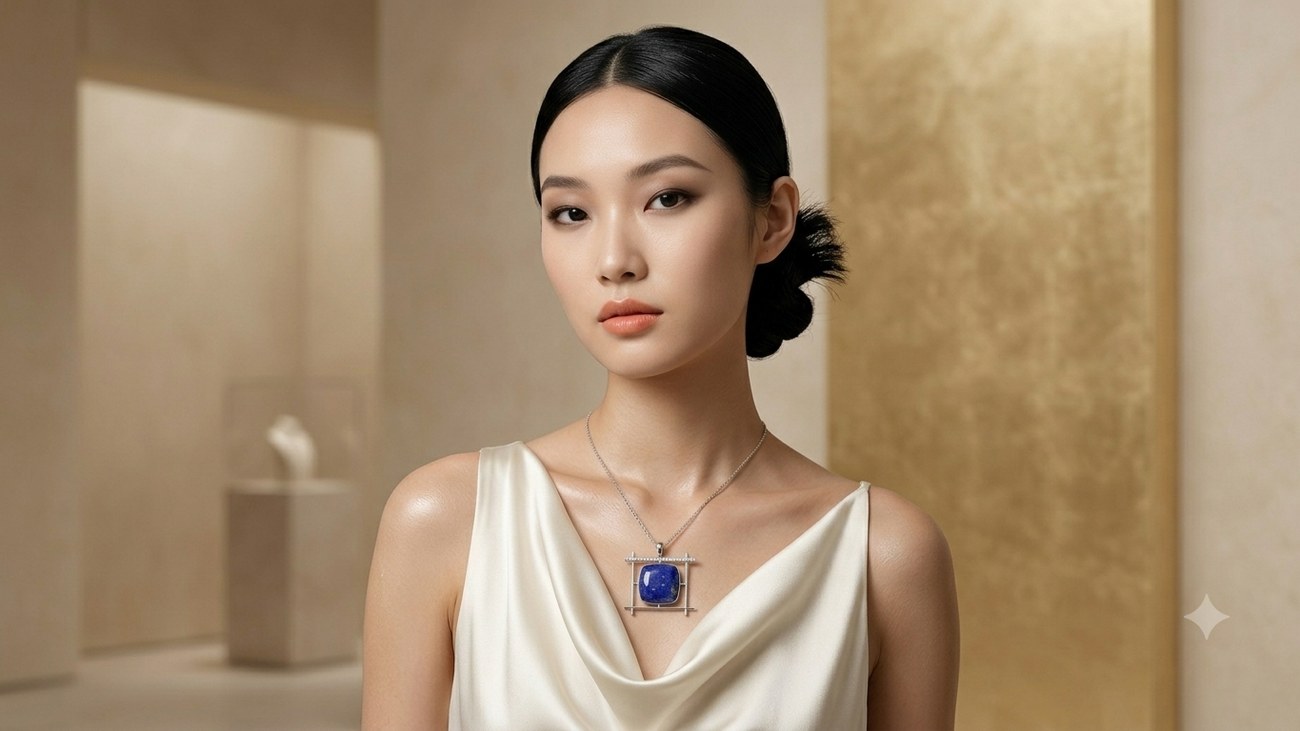
Lapis is not a single mineral but a rock: mostly lazurite, which gives the blue, with pyrite for the gold flecks and calcite for the white veining. The best material is an even, saturated blue with a scattering of pyrite rather than large white patches.
How it looks in different light
Holds its colour under almost any light, which is unusual for a blue stone. The pyrite catches direct light and glints, so it is more alive in sun or under a spotlight than in flat shade.
Natural characteristics
Pyrite distribution and calcite veining differ in every single stone. Two lapis pieces from the same batch will not match, and this is the character of the material.
Durability and care
At 5 to 6 this is the softest stone we set. It scratches easily, dislikes heat, and should never be soaked. Wipe with a barely damp cloth. No soap, no ultrasonic, no steam.
The full care guide covers storage, cleaning and what to avoid across every stone we set.
Traditional associations
In crystal traditions Lapis Lazuli is most often connected with clarity and confidence. In Vedic astrology the stone is associated with Shani, Saturn.
Wearing Lapis Lazuli
We set Lapis Lazuli in the Drishti Drop, the Infinity Stud and the Triad Ring. Against rhodium-finished silver it reads cool and recessive, which is the point: the metal holds the stone and gets out of the way.
In this stone
3 pieces in Lapis Lazuli
Keep looking