The stone guide
Labradorite
The flash hiding in grey.
- Mineral family
- Feldspar
- Colour
- Grey to smoke, with a blue, green or gold flash
- Hardness
- 6 to 6.5 on the Mohs scale
- Usual cut
- Cabochon, cut and oriented to catch the flash
- Traditionally for
- Transformation, Protection, Intuition
- Origin
- Sourced through our Jaipur partner
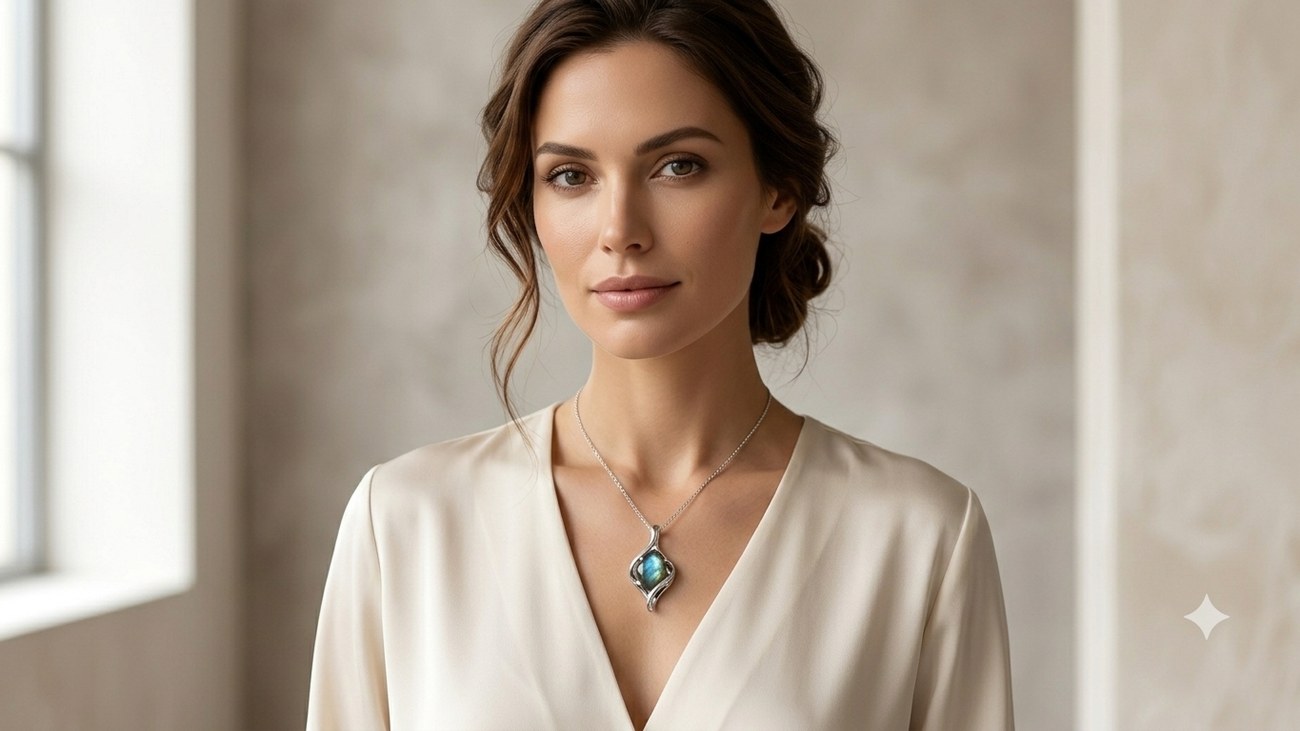
What it actually is
Turn a labradorite past the wrong angle and it is grey stone. Turn it back and it lights up peacock blue or green. The effect is called labradorescence, and it comes from light interfering with layers inside the crystal. The cutter's real skill is orienting the stone so the flash lands where you will actually see it.
How it looks in different light
Labradorite needs a direct light source. Under a window or a lamp it is spectacular. In flat, diffuse light it goes quiet and grey. A piece that looks dull in a shop and extraordinary outdoors is behaving exactly as it should.
Natural characteristics
The dominant flash colour varies from stone to stone: blue is most common, green next, gold and violet are rarer. The base grey varies too. Fine dark lines running through the stone are twinning planes, a structural feature of the mineral.
Durability and care
Same hardness and same caution as moonstone: store apart, avoid knocks, clean with warm soapy water and a soft cloth. No ultrasonic, no steam.
The full care guide covers storage, cleaning and what to avoid across every stone we set.
Traditional associations
In crystal traditions Labradorite is most often connected with transformation, protection and intuition.
Wearing Labradorite
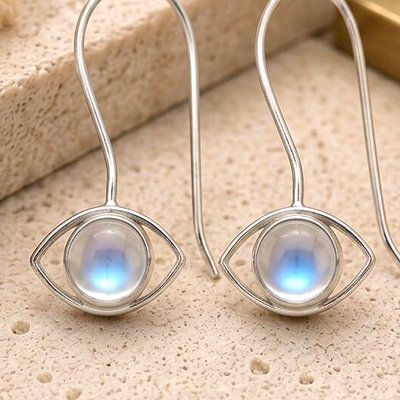
We set Labradorite in the Aperture Ring, the Crescent Pendant, the Drishti Drop, the Halo Drop, the Halo Ring, the Oculus Cuff, the Strand Bracelet, the Tablet Pendant and the Wave Cuff. Against rhodium-finished silver it reads cool and recessive, which is the point: the metal holds the stone and gets out of the way.
In this stone
9 pieces in Labradorite
Keep looking