The stone guide
Ethiopian Opal
Every colour, briefly.
- Mineral family
- Opal, hydrated silica
- Colour
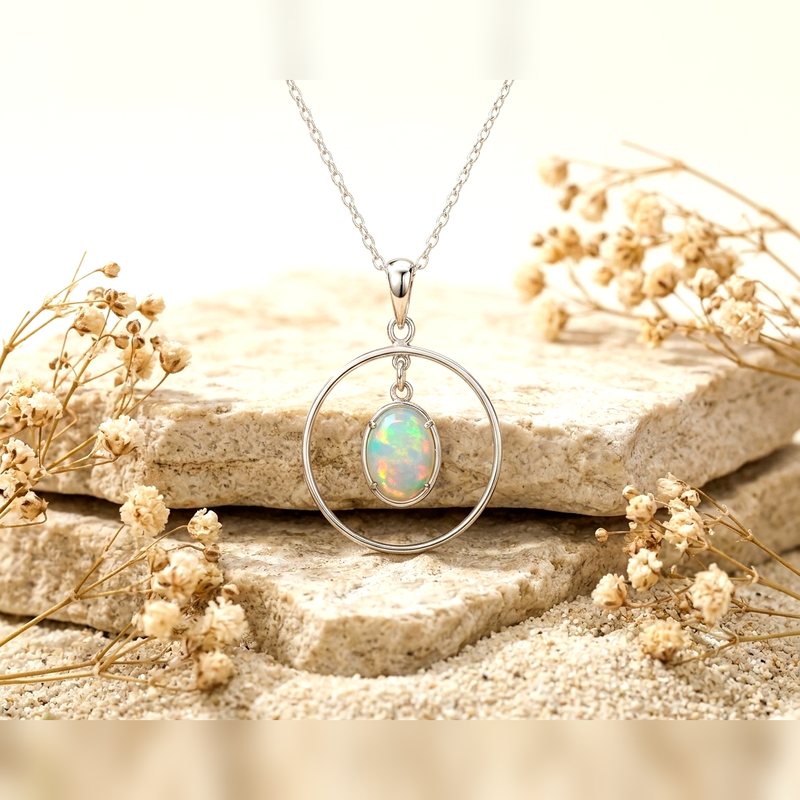
- Translucent milky body with flashes of green, orange and pink
- Hardness
- 5.5 to 6.5 on the Mohs scale
- Usual cut
- Cabochon, to hold the play of colour
- Traditionally for
- Transformation, Intuition, New Beginnings
- Origin
- Sourced through our Jaipur partner
What it actually is
Opal does not get its colour from a pigment. It is built from microscopic spheres of silica packed in a lattice, and light diffracts as it passes between them. The size of those spheres decides which colours you see, which is why one stone flashes green and another red. The effect is called play-of-colour, and it moves across the stone as you tilt it.
How it looks in different light
Ethiopian opal is at its best in bright, direct light, where the play-of-colour separates into distinct patches. In dim light it reads as a soft milky stone with a faint glow. Unlike moonstone, the colours here are genuinely multiple rather than a single sheen.
Natural characteristics
No two opals are remotely alike, and this is truer of opal than of any other stone we set. The dominant flash colour, its pattern and its coverage differ completely from stone to stone. Ethiopian opal is also hydrophane, meaning it can absorb water and turn temporarily translucent before drying back.
Durability and care
The most delicate stone in the collection. At 5.5 to 6.5 it scratches easily, and because Ethiopian opal is hydrophane it should never be soaked, worn in water, or exposed to oils and perfume. Wipe with a dry soft cloth only. No ultrasonic, no steam, no soap.
The full care guide covers storage, cleaning and what to avoid across every stone we set.
Traditional associations
In crystal traditions Ethiopian Opal is most often connected with transformation, intuition and new beginnings.
Wearing Ethiopian Opal
We set Ethiopian Opal in the Iris Pendant. Against rhodium-finished silver it reads cool and recessive, which is the point: the metal holds the stone and gets out of the way.
In this stone
1 pieces in Ethiopian Opal
Keep looking